
- Call Us 1 306-745-2711
-
Follow Us

The Ultimate Bale Carrier Guide: Capacity, Compatibility & Safe Transport
Moving bales from the field to storage is historically one of the most time-consuming and labour-intensive parts of the harvest. If you’re operating with small, single-bale movers or standard flatbeds, you’re likely spending more time driving back and forth than actually clearing your field.
If you’re planning to scale your operation, upgrading to a dedicated commercial bale carrier is an excellent next step. In this bale carrier guide, we’ll break down how to evaluate bale carrier capacity and compatibility, streamline your loading workflows, and cut down your cycle times.
Understanding Your Bale Carrier’s Capacity and Compatibility
When it comes to transporting forage efficiently, capacity simply comes down to two things: Gross Vehicle Weight (GVW) and deck length. The strength of the frame, axles, and tires all dictate how much weight you can safely haul, while the deck length determines how many bales you can fit per trip.
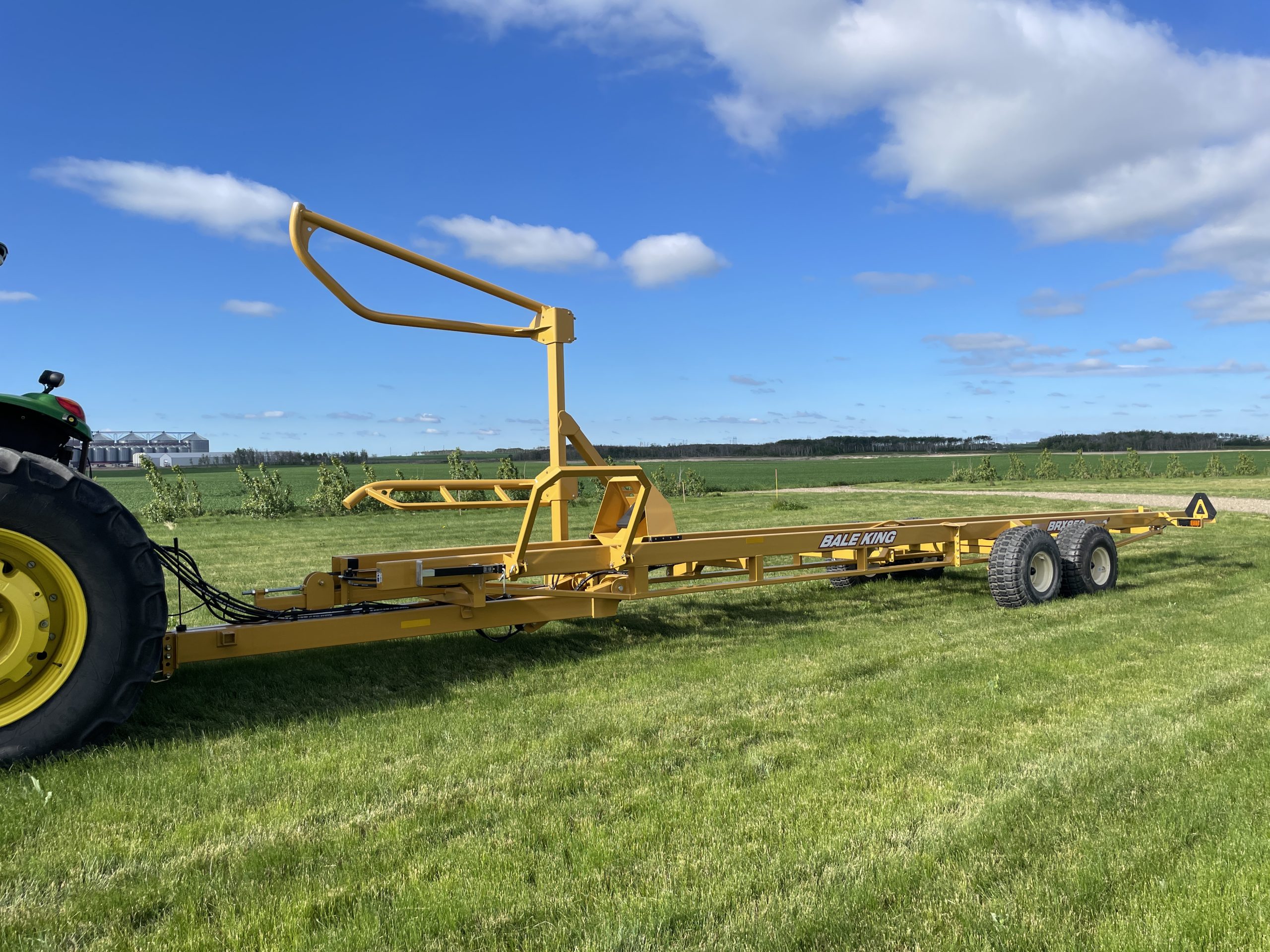
High-throughput machines like the Bale King BRX850 feature an extended frame and heavy-duty tandem axles engineered to comfortably haul eight 5-foot-wide bales, rather than the standard seven.
Field to Stack: Optimizing the Loading Workflow
An efficient carrier should eliminate the need for two separate operators – one in a tractor loading a flatbed, and another driving a truck. Modern moving systems convert this into a streamlined, single-operator workflow.
Beyond that, your carrier is always with you. Stop leaving your truck and trailer in the middle of the field, driving to each bale and then having to drive back to the trailer. Minimize load time and compaction across your field.
Loading steps
- Approach: Thanks to an integrated 1/4-turn fork, you can approach bales from either direction. The fork automatically aligns the bale perfectly for loading, so you can drive in the most efficient pattern to save time.
- Lift and Rotate: The arm engages, cleanly lifting the bale and rotating it onto the main dual-rail bed without tearing the net wrap or twine.
- Hydraulic-Advance: As subsequent bales are gathered, the carrier’s integrated mechanical push bar shifts the loaded bales rearward.
This automated flow keeps the tractor in constant, forward motion, drastically cutting the fuel consumption and structural wear-and-tear caused by repetitive loader-tractor cycles.
Lightning-Fast Unloading
While a truck and trailer might save a few minutes on highway travel speed, a dedicated carrier wins the race at the stackyard. You can completely unload a machine like the BRX850 in about two minutes. Compare that to unloading a flatbed one bale at a time with a second tractor, and the time savings are massive.
Safe Transport Dynamics: Securing the Payload
Transporting heavy loads comes with significant risk, especially when moving from rough field terrain onto public secondary highways. For added safety on the road, the BRX850 features a 9-foot overall width to ensure safe, stable transport while providing excellent visibility in your tractor mirrors.
Pre-Transport Safety Checklist:
- Check Tractor Ratings: Ensure your tractor is fully rated to handle both the total towed weight and the heavy hitch weight on the drawbar.
- Inspect Wheel Bearings & Tires: Check that wheel bearings are well-greased and tires are inflated to correct field/road PSI specs to handle maximum tonnage.
- Clean the Chassis: Clear loose hay and debris away from the frame, lights, and reflective tape.
- Verify Visibility: Check your taillights to ensure they’re visible and functioning properly. Also, verify that your Slow Moving Vehicle (SMV) sign is clean and visible to trailing vehicles.
Reducing Handling Risks and Protecting Forage Quality
Every single time a piece of machinery touches a bale, the forage risks losing value. Rough handling with traditional loader forks can puncture net wrap or break twine, causing bales to fall apart or spoil during storage.
The BRX850 uses a wide-diameter pipe structure on the lift arms and transport rails instead of sharp forks, allowing the equipment to slide easily under the bale. This keeps the outer shell of your bale tight so the feed value remains completely intact when it reaches the storage stack.
Investing in Farm Efficiency
Choosing the right bale carrier comes down to reducing your cost-per-bale moved. By optimizing your bale carrier capacity and compatibility, you can eliminate operational bottlenecks, secure your workflows against transport hazards, and maintain feed quality. Don’t let your harvest stall at the moving stage – invest in a bale carrier built to keep pace with modern high-speed agriculture.
Ready to make your field cleanup ultra-efficient? Explore the Bale King BRX850 Bale Carrier and see how fast your harvest can move.
Contact Bridgeview Manufacturing today to start building yours!