
- Call Us 1 306-745-2711
-
Follow Us

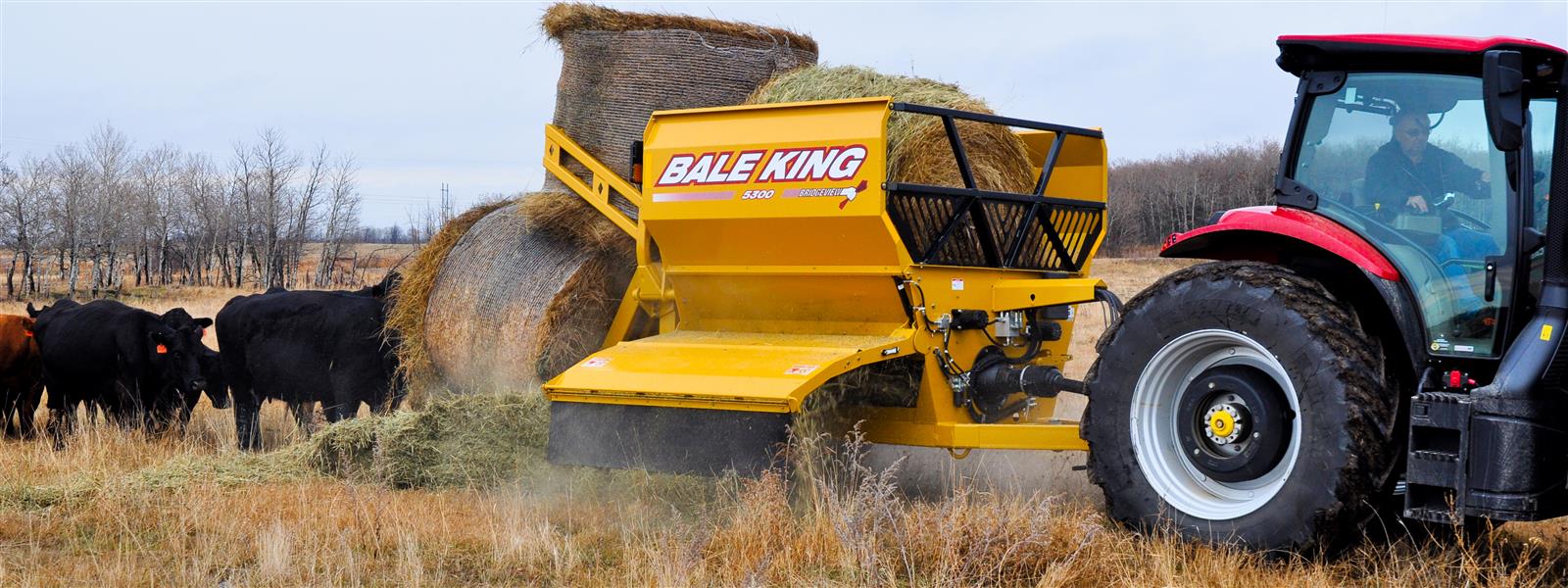
How to Set Your Bale Processor for Different Feed Conditions
With the rising cost of feed and bedding, your bale processor is critical to maximizing feed value and reducing waste. That said, the wrong bale processor setup can lead to increased wear and tear, plugging, wasted horsepower, and poor feed quality.
With the help of Bale King and Bridgeview Manufacturing, you can master the key adjustments—rotor speed, feed rate, and grate setting—to achieve optimal results for every bale type. In this blog, we’ll outline a proper bale processor setup to help you maximize your feed and your efficiency.
Why Bale Processor Setup Matters
With the right bale processor setup, you can:
Increase Operational Efficiency
- Fuel/Power Savings: Correct settings reduce unnecessary strain and prevent plugging, minimizing downtime and saving tractor horsepower.
- Faster Processing: Dry materials can be processed quickly when settings are optimized.
Maximize Bale/Feed Quality
- Digestibility: Achieving the optimal particle size ensures livestock consume the material efficiently.
- Reduced Waste: Proper processing size prevents animals from sorting feed or using excess as bedding, ensuring high-nutrient fines (like alfalfa leaves) are consumed.
- Better Bedding: Uniform spread and longer material create a cleaner, more absorbent bedding area.
The Three Core Adjustments for Your Bale Processor Setup
-
Rotor Speed
For optimal operation, you should maintain full operating speed of 1000 PTO RPM, to eliminate flail “backslap,” severe vibration, and damage to the flails and bearings.
-
Grate Setting
This setting adjusts the amount of flail protrusion above the grate. Greater flail protrusion results in faster processing and a coarser cut at the expense of higher vibration levels. Less flail protrusion offers a finer cut and smoother operation in tough material.
-
Feed Rate — Roller Speed/Chain Speed
The feed rate controls how quickly the bale is delivered to the spinning rotor. Often overlooked, it is equally significant to the machine’s aggression as the grate setting. A good starting point for bale roller speed is 40RPM, while chain-style processors can start around 100RPM shaft speed. Adjust with your tractor’s flow control valve or an optional Bale King flow control valve.
-
Rotation Direction
Rotate the bale counter-clockwise as viewed from the tractor as much as possible. Only reverse as necessary to clear loose material. This way, the rotor assists rotation and promotes smooth, even feeding.
-
Processing Time
Processing time is dependent on a number of factors, including feed type, moisture content, and weather conditions. Times may vary from 1:00 – 1:30 for a dry bale to 3+ minutes for a silage bale. Listen to your machine—if vibration is excessive, raise your hoop grate and slow the bale rotation to compensate.
Condition-Specific Settings
Wet Hay & Silage
Wet hay and silage can lead to plugging or power strain on your bale processor. To prevent this, keep your feed speed to a minimum and your grate setting high for a finer cut. This will allow wet, tough materials to pass through, while reducing strain on your driveline.
Dry Hay
For dry hay, the goal is to maximize throughput speed while minimizing nutrient loss. A good starting point is 40RPM on the bale rollers or 100RPM shaft speed on a chain-style processor. A medium grate setting (2-4) is ideal for dry hay.
Straw
When processing for bedding or mulch, the goal is to achieve the longest spread distance and fluffiest material. To achieve this, use a higher feed rate and a medium grate setting. This will reduce processing time while increasing the material length to improve spread.
TMR/Fine Cut Rations
To achieve a specific short particle size for blending, set your bale processor’s feed rate to slow or medium. It’ll take longer to process, but when combined with a high grate setting, it will produce uniform, short particles for optimal digestion.
Matching the Bale King to Your Operations
At Bridgeview Manufacturing, we carry a range of bale processors, each designed to meet a specific purpose. Choosing the right machine for your operation is the first step in effective bale processor setup.
Bale King 5325
This model pairs a rugged roller-style processing unit with a 100-bushel grain tank for high-volume feed delivery to your cows.
Bale King 5400
Our standard model, the Bale King 5400, is ideal for a wide range of feed conditions. It’s an all-around processor, and easily switches between dry hay, straw, and light silage. It can be optioned with our exclusive 3-bale, grain tank, and rotary straw assist kits.
Bale King 6300
With its 6-bale capacity, this processor is great for high-volume feeding and bedding. It’ll keep up with operations that require substantial daily volume.
Bale King 7450
Its chain-and-slat feeding system, accessible rotor, and optional 3-bale kit make the 7450 a productive, easy-to-operate tool.
Bale King 8300
For maximum flexibility, look to the Bale King 8300. This workhorse is built for both round bales and square bales up to 4x4x8.
Fine-Tuning Your Future
Proper bale processor setup isn’t just a one-time process—it’s a dynamic that will change based on the moisture, density, and intended use of your bales. This attention to detail will pay off in the end, with reduced feed costs and higher feed quality.
If you’re looking to maximize your operation’s efficiency and bale processing, it’s time to call Bridgeview Manufacturing.