
- Call Us 1 306-745-2711
-
Follow Us

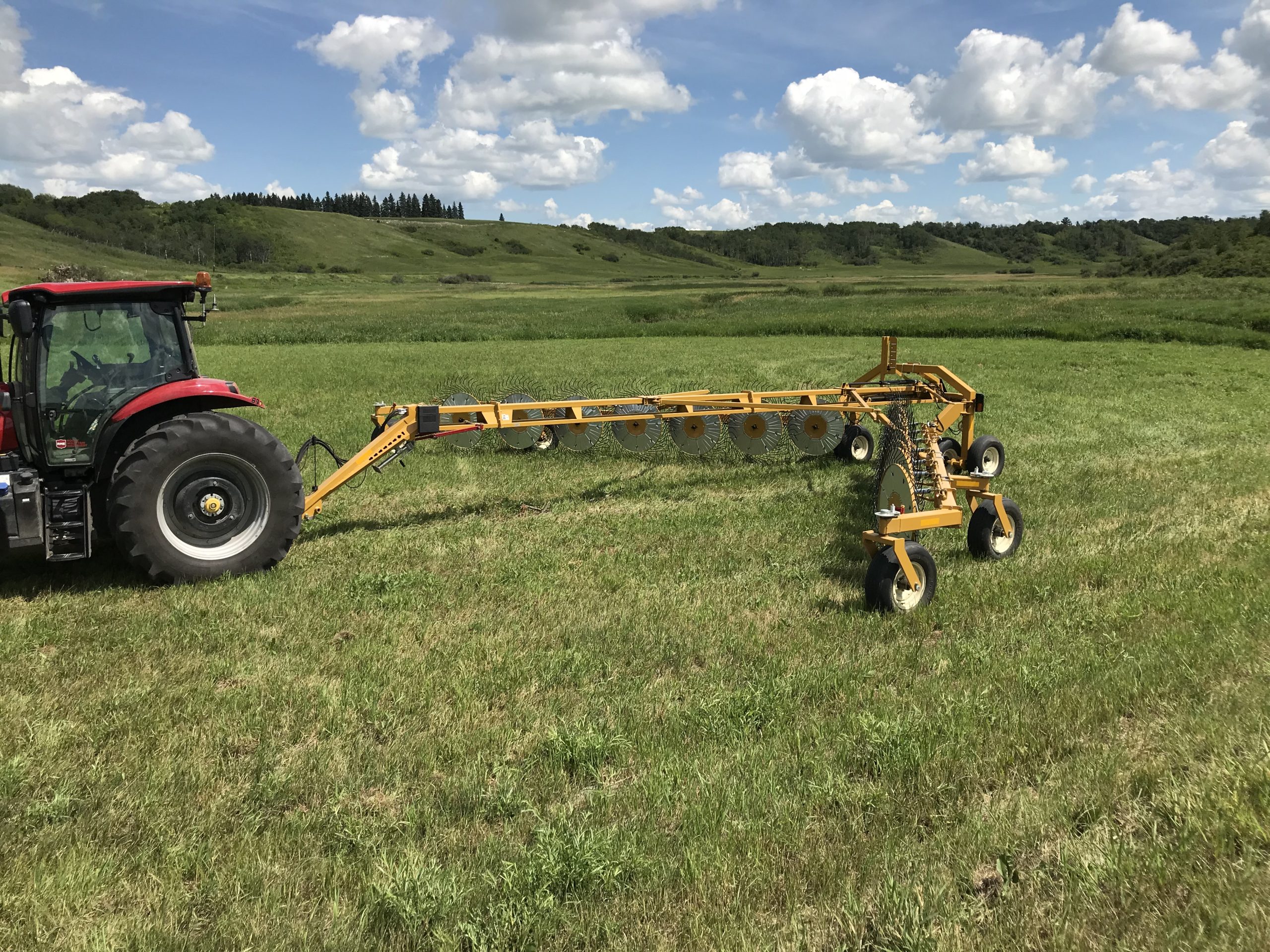
Choosing the Best Hay Rakes: Why it Matters for Your Farm
You know that producing high-quality forage is key to a successful operation. While many farmers focus on the baler as the star of the show, the truth is, even the most advanced baler can’t make up for a poor windrow. That’s where your hay rake comes in.
There are a number of hay rakes on the market, each boasting unique features and functions designed to handle different crop conditions and environmental challenges. While it’s good to have options, it can also make deciding on the best hay rake for your farm difficult.
Heavy-duty equipment is no small investment. You want to be sure it pays off in efficiency, forage quality, and ultimately, your bottom line. Your hay rake is essential for creating uniform, high-quality windrows that maximize your baler’s performance and preserve the nutritional value of your crop.
To help you decide, we’ll cut through the confusion and discuss what you need to consider when choosing the best type of hay rake for your agricultural operation. Let’s make sure your next equipment purchase is the right one.
Factors to Consider
Operation Size
Consider the scale of your farming operation to determine the best hay rake to match your needs. Whether you’re working in a small field or a vast acreage will dictate your required coverage and speed.
Crop Conditions and Cutting Equipment Width
The main goal is to maximize your baler’s efficiency without overloading it. For windrowed hay, you’ll need to decide if you should rake 2 windrows together or step up to a larger rake to reach 3 windrows. In mowed hay, consider your average yields and select a rake width that best matches your conditions.
Forage Crop Type
Consider how delicate or heavy your typical forage is. Delicate crops, like alfalfa, require a gentler rake, whereas clover or grass needs a robust rake to handle their density and maintain crop integrity.
Field Conditions
Consider both the terrain and the field shape you’re dealing with before selecting the type of hay rake. A rake with a flexible frame or adjustable settings may be required for performance across varying slopes or irregularly-shaped fields.
Type of Cut
Consider whether you’re working with a mowed or windrowed cut. Mowed hay needs closer wheel spacing and additional rake tines to handle fine, short straw effectively. In contrast, windowed hay requires larger raking wheels and controlled ground pressure to manage heavier, thicker crops efficiently. The best hay rake for your farm will offer versatility for both.
Budget
Look at more than just the initial investment. Consider long-term value and overall return on investment. Purchasing a high-performing hay rake can reduce long-term maintenance and repair costs, and increase your operation’s efficiency.
Common Mistakes to Avoid When Buying a Hay Rake
- Focusing only on Wheel Count: Not all 12 wheel rakes are the same. Usable raking width is affected by rake wheel diameter, wheel spacing, and boom angle. Be sure to consider actual raking width dimensions when comparing rakes.
- Overlooking Window Width Adjustability: Hay crops can vary widely across a field. A fixed window width wheel rake might leave a nice windrow in heavy conditions, but might leave 2 small separate windrows in light portions of the field, which makes uneven bales. High-end rakes feature hydraulic windrow-width adjustment that lets you adjust for varying field conditions on the fly.
- Buying for Field Size Alone: A massive rake might seem efficient, but if it can’t navigate your narrow gates, tight corners, or irregular field shapes, it’ll slow your operation down.
- Overlooking the Full Haying Process: Choosing a rake without considering how the resulting windrow interacts with your specific baler often leads to poor feeding and frequent machine plugs.
Types of Hay Rakes
No matter your needs, Bridgeview Manufacturing has the best wheel rake for you. Our Bale King series prioritizes durability, efficiency, and a superior windrow formation.
Bale King VR581
This agricultural workhorse is ideal in rough or challenging ground conditions. Available with 12 to 14 wheels, these rakes are built for exceptional durability and are specifically engineered to withstand and perform reliably in rugged terrain. Maximize production and efficiency in areas where other hay rakes might struggle.
This model delivers:
- The largest raking wheels for efficient crop handling
- In most cases, a 12-wheel VR581 matches well with an 18ft haybine
- The most tines for a clean sweep
- Bridgeview’s patented spring suspension system for rough ground
- Large implement tires for stability
- Hydraulic windrow width adjustment on the fly
Bale King VR683
Ideal for large-scale operations, the VR683 delivers up to 42 feet of coverage. It features a high-clearance flex frame that adapts perfectly to ground contours, a supersteer turning radius for excellent maneuverability in tight spaces, and three full-sized kicker wheels to ensure thorough, even windrow formation by moving the center crop. This hay rake is designed for high-capacity, high-quality output.
This 18 to 22-wheel supersteer offers:
- Up to 42 feet of raking coverage
- Supersteer turning system for tight headland turns
- 3 full-size kicker wheels
- A heavy-duty flexible frame
- Hydraulic windrow width adjustment
- 10 robust implement tires
- Spring tine or rubber-mounted tine options to suit your crop type
Which Bale King Hay Rake Is Best for Your Farm?
Choosing between our premier models comes down to your terrain and baler capacity. If your acres are characterized by rugged, uneven terrain and require aggressive ground handling, the Bale King VR581 provides the structural heavy-duty durability and suspension to handle the punishment.
If your priority is massive capacity, wide coverage, and maximum efficiency across large acreages without sacrificing maneuverability, the Bale King VR683 is engineered to level up your productivity.
Finding the Right Solution for Your Operation
Whether you’re dealing with challenging landscapes or aiming for the most efficiency, Bridgeview’s Bale King hay rakes deliver. No matter the size, shape, or output of your operation, we’ve got the best hay rake for your farm to make sure the job gets done properly.
Don’t settle for less when it comes to your valuable crops. Contact Bridgeview Manufacturing to find the hay rake that’s right for you.
Frequently Asked Questions
1. How do I know when it is time to replace my hay rake?
If your hay rake is leaving uneven windrows, missing crop, causing frequent breakdowns, or requiring more maintenance than usual, it’s time to consider an upgrade.
2. Can the wrong hay rake affect hay drying time?
Absolutely! A hay rake that creates uneven or overly dense windrows can slow drying and make baling less efficient. A properly matched rake with on-the-fly windrow width adjustment helps create consistent windrows that support better airflow and more even drying.
3. How important is rake width when choosing a hay rake?
The key is balancing your rake choice between average yields and baler capacity. A large rake in a heavy crop can overload your baler and take the fun out of baling. Alternatively, a small rake in light crops won’t maximize the efficiency of your baler. In variable conditions, wheel rakes are able to maintain most raking performance even when the wings are not fully extended, so you can have the ability to narrow the raking width in unusually heavy crops.
4. Should I choose a hay rake based on my tractor size?
Yes. Your tractor’s horsepower, number of hydraulic remotes, and hitch setup should match the rake you choose. Before you buy, make sure the hay rake is compatible with your tractor and your operation’s setup.
5. How can I reduce leaf loss when raking hay?
Avoid raking when hay is too dry, use proper rake settings, and choose equipment that handles forage gently. This is especially important for crops like alfalfa, where leaf retention has a major impact on forage quality.
7. Is a larger hay rake always better?
Not always. A larger hay rake can improve efficiency on big fields, but it may not be the best choice for smaller farms,heavy crops, narrow gates, uneven terrain, or irregular field shapes. The best hay rake should match your acreage, field conditions, tractor, and baling setup.
8. How does the hay rake setup affect baler performance?
The rake setup affects the size, shape, and consistency of the windrow. If the windrow is too wide, too narrow, or uneven, the baler may feed poorly, plug more often, or produce inconsistent bales.