
- Call Us 1 306-745-2711
-
Follow Us

Hay Rake Maintenance Checklist: What to Inspect Before Haying Season
When your crop is ready, the haying window waits for no one. A single breakdown during peak season can stall an entire harvest, leaving valuable forage vulnerable to the elements.
While the baler often gets the spotlight, your hay rake determines windrow uniformity, drying speed, and overall bale quality, which directly impacts your bottom line. Taking a couple of hours now for an inspection ensures your equipment is field-ready when you need it.
Using our field-tested hay rake maintenance checklist before you head out can help you identify common wear points and keep your operation moving smoothly.
Hay Rake Maintenance Checklist
1. Inspect the Tines and Rake Wheels
Your rake wheels do the heavy lifting, and the tines take the brunt of field friction. Over a long winter, minor issues can turn into sudden field failures.
- Look for Missing or Bent Tines: Check for cracked, deeply grooved, or broken tines. Missing tines leave hay behind, while severely bent ones disrupt the windrow flow. Replace them in batches if they show uniform wear.
- Test Wheel Bearings: Manually spin each rake wheel. They should rotate smoothly without grinding, clicking, or excessive wobbling. Loose or noisy bearings need to be replaced immediately to avoid hub damage.
2. Evaluate the Structural Frame and Pivot Points
Heavy-duty wheel rakes undergo a great deal of stress as they travel over uneven terrain.
- Check the Welds: Walk the length of the frame. Pay close attention to high-stress areas around the hinge points, wing joints, and the main drawbar. Look for hairline cracks or paint flaking, which indicate underlying metal fatigue.
- Lubricate Pivot Points: Grease all mechanical pivot points, wing hinges, and slide tracks. Fresh grease helps to flush out accumulated dust, moisture, and old, crusty lubricant that can accelerate wear.
3. Review Hydraulics and Transport Systems
If your hoses leak and your hydraulic cylinders creep, your season will stop before it even starts.
- Inspect Hoses and Fittings: Relieve the pressure in your hydraulic system, then visually inspect it. Look for cracking, weathering, or weeping at the crimps.
- Test Cylinders: Hook the rake up to your tractor and cycle the hydraulics. Ensure the lifting arms and wing extensions move evenly and hold position when released. If they lag or creep, check for air trapped in the system, worn cylinder seals, or damaged hydraulic tips.
4. Check Tires and Hubs
Rake tires sit idle for months, making them prone to dry rot and slow leaks that may only show up under a full load.
- Pressure and Tread: Ensure inflation pressure is uniform across all transport and caster wheels for consistent rake height.
- Wheel Hubs: Ensure the lug nuts are torqued properly and inspect the caster wheels to confirm they swivel freely without binding.
Hay Rake Maintenance Checklist at a Glance
Hay Rake Maintenance Checklist at a Glance
| Category | Component to Check | What to Look For | Action Needed |
|---|---|---|---|
| Ground Engagement | Rake Tines / Teeth | Broken, missing, or heavily worn metal | Replace damaged tines |
| Ground Engagement | Wheel Bearings | Side-to-side play, rough rotation, or grinding | Repack or replace bearings |
| Hydraulics | Lines & Fittings | Scuffs, weather cracks, or wet fluid leaks | Replace compromised hoses |
| Hydraulics | Cylinders | Scratched or rusted rods, or leaking fluid seals | Rebuild or replace cylinders |
| Structure | Frame & Welds | Hairline cracks or peeling paint near joints | Repair welds before field stress |
| Structure | Grease Zerks | Blocked fittings or dry joints | Flush and pump with fresh grease |
| Mobility | Tires & Casters | Low PSI, dry rot, or bound caster bearings | Inflate to spec and lubricate casters |
Upgrade to Field-Proven Reliability
If your current rake spent more time in the shop than the field last year, it might be time to look at equipment designed to handle demanding high-tonnage conditions.
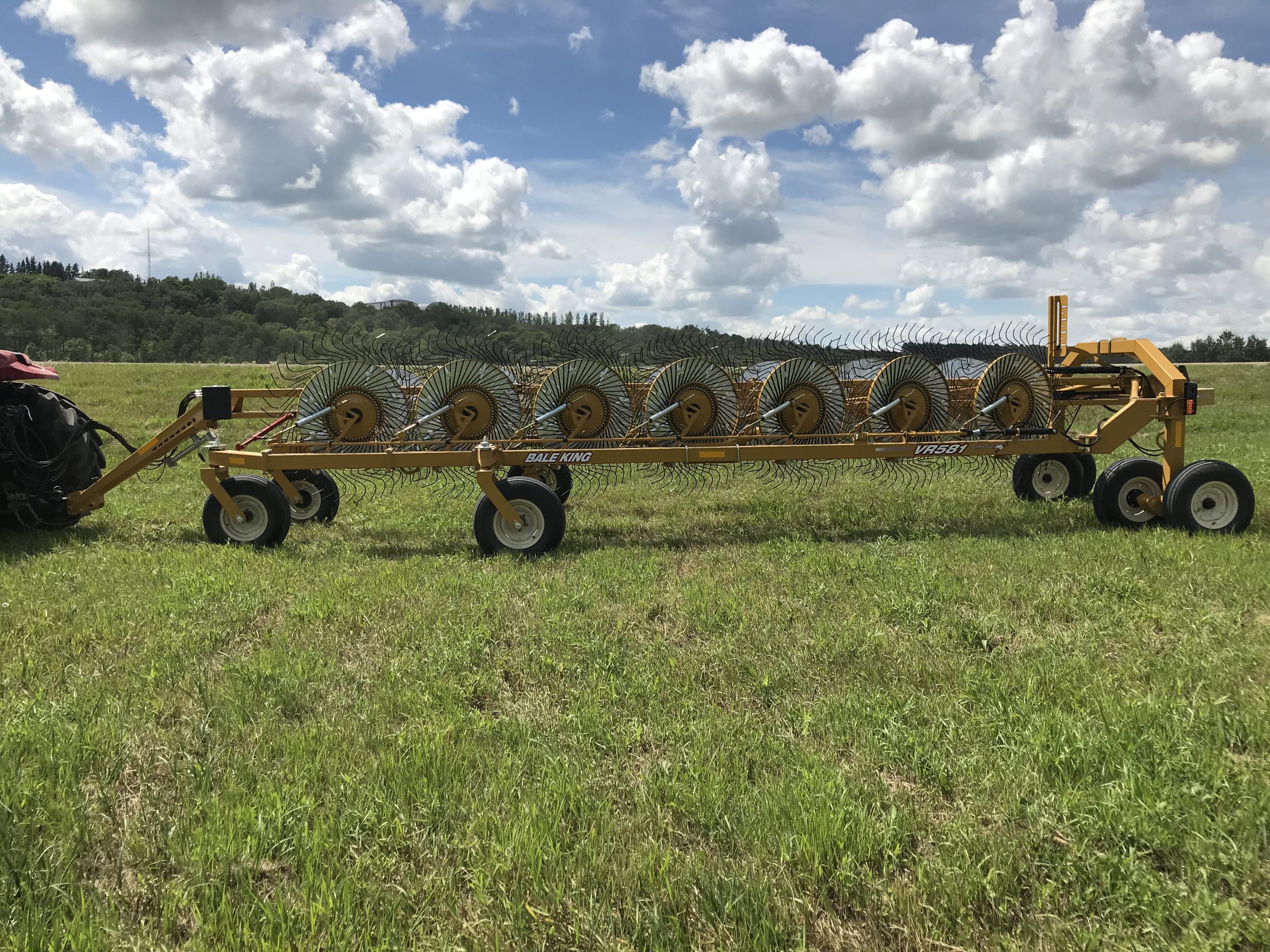
The Bale King VR581 offers an exceptionally rigid frame design with simple, independent wheel float adjustments to minimize crop contamination. For large-scale operations requiring maximum efficiency and tight turning performance, the Bale King VR683 features a patented steering mechanism that follows the tractor flawlessly around tight corners without gouging the turf.
Contact Bridgeview Manufacturing to explore our line of hay rakes to find the right fit for your operation.